
Stage alignment
Each stage-level environment uses the matching physical success predicate from the long task.
Pick three debris blocks into a dustpan, then tip all three into a trash bin.
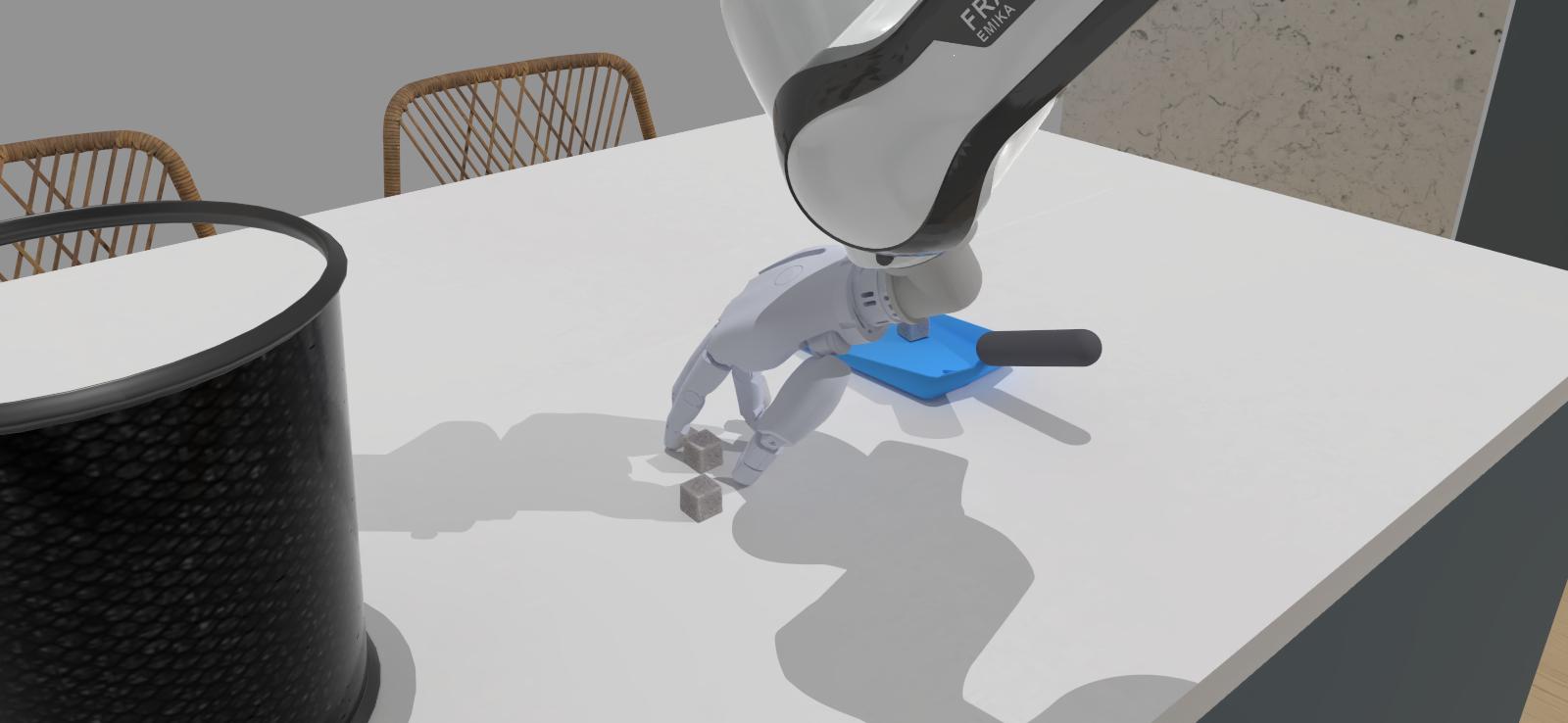 Stage 01 / 02
TableClean-v1Canonical instructions, handedness, action width, horizon, and success conditions are drawn from the current task registry and success-contract documentation.
| # | Stage / environment | Hand | Action | Max steps | Success summary |
|---|---|---|---|---|---|
| 01 | Collect debrisTableCleanPickDebris-v1 | Right | 29 | 900 | Place all three blocks inside the dustpan, release them, and hold stable for eight steps. |
| 02 | Dump dustpanTableCleanDumpDustpan-v1 | Right | 29 | 600 | Move all three blocks into the bin-bottom region and hold for ten steps. |
Stage success in the training scene (%, 50 episodes). Best scores in each row are highlighted.
| Stage | PPO | RLPD | ACT | Diffusion Policy | GR00T | π0.5 |
|---|---|---|---|---|---|---|
| PickDebris | 0.0 | 0.0 | 0.0 | 2.0 | 0.0 | 0.0 |
| DumpDustpan | 0.0 | 0.0 | 92.0 | 70.0 | 82.0 | 78.0 |
| Stage | PPO | RLPD | ACT | Diffusion Policy | GR00T | π0.5 |
|---|---|---|---|---|---|---|
| PickDebris | 1.3 ± 2.3 | 0.0 ± 0.0 | 0.0 ± 0.0 | 0.0 ± 0.0 | 1.3 ± 1.2 | 0.0 ± 0.0 |
| DumpDustpan | 0.7 ± 1.2 | 0.0 ± 0.0 | 59.3 ± 17.9 | 1.3 ± 2.3 | 88.7 ± 2.3 | 68.0 ± 4.0 |
| Task | PPO | RLPD | ACT | Diffusion Policy | GR00T | π0.5 |
|---|---|---|---|---|---|---|
| Table cleaning | 0.0 | 0.0 | 0.0 | 0.0 | 0.0 | 0.0 |
Source: manuscript experiment tables. Compare all methods and tasks →
Each stage-level environment uses the matching physical success predicate from the long task.
Hold counters or latches prevent unstable contact from being counted as task completion.
State and action traces can be restored and replayed for validation and offline rendering.